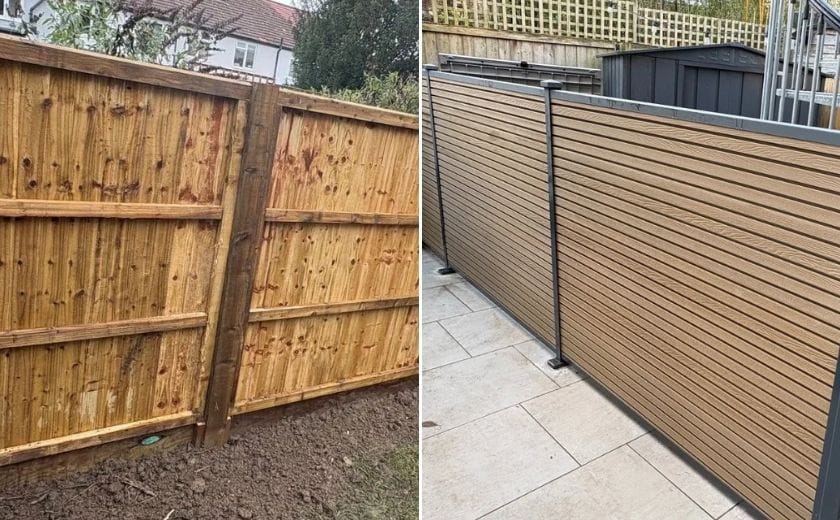
People usually ask us this before they’ve decided anything else about their fence. Not the height, not the colour – just timber or composite, because that’s the decision everything else hangs off.
We get asked it most weeks. And the honest answer is we install both, so we’re not trying to talk anyone into one over the other.
Timber’s the one most people picture when they think “garden fence.” Composite’s newer, and it exists mainly to solve one problem: maintenance. That’s really what this whole decision comes down to once you strip away the rest.
We do a lot of fencing services across Surrey, and timber still makes up the majority of the fencing work we do, so we know it inside out. But we’d be doing you a disservice if we didn’t tell you straight when composite is the better call, which does happen.
This is the practical version of that conversation – the one we’d have with you on site, minus the bit where we measure your garden.
Timber Fencing, Properly Explained
Closeboard, overlap, picket – it’s all timber underneath, just different ways of arranging it. It’s the material almost everyone defaults to, partly because it’s familiar and partly because it just works in most gardens.
There’s a reason it suits older properties and traditional gardens so well: it’s real wood, so it ages like real wood. Some people love that. Against brick, against planting, next to a lawn – it tends to look like it’s always been there, even when it’s brand new.
Repairs are usually simpler too. Damage one panel and, posts permitting, you can often just replace that section rather than tearing out the whole run.
The catch – and there’s always a catch – is that timber needs looking after. Staining, treating, the odd repair here and there. Skip that for a few years and it shows.
Our timber fencing services page covers the styles if you want to see what’s actually on offer.
Composite Fencing, Properly Explained
Composite’s made from wood fibre bonded with recycled plastic. The whole point of it is durability without the upkeep – fit it, and that’s largely the last you think about it.
It suits a different kind of garden. Newer builds, modern extensions, anywhere a homeowner wants every panel looking identical rather than weathering with character. That uniformity is either the main selling point or slightly soulless, depending who you ask.
It costs more to install. Noticeably more, in most cases. Whether that’s worth it is really a question about your own patience for maintenance, not about the fence itself.
See composite fencing services if low maintenance is non-negotiable for you.
Quick Comparison
| Factor | Timber | Composite |
| Appearance | Natural, warm | Modern, uniform |
| Upfront cost | Lower | Higher |
| Maintenance | Ongoing | Minimal |
| Durability | Good with care | Strong with correct installation |
| Repairs | Section-by-section | Depends on the system |
William’s view: Timber’s still the first thing I bring up for most traditional gardens – it’s the sensible default. But if maintenance is genuinely the homeowner’s main worry, that conversation changes fast, and composite gets a proper look-in.
What We’re Actually Weighing Up On Site
Most people assume the material comes first. It doesn’t, really.
What we’re actually looking at is the boundary itself – is the old fencing coming out, what state are the posts in, can we even get materials into the garden easily. Then there’s the stuff you can’t see from the street: how the ground drains, how exposed the spot is to wind, whether the existing fence line is even straight.
Height, privacy, gates, budget – all of that comes after the practical groundwork, not before it.
Worth knowing too that there are general rules around fence height and planning permission for UK boundaries, which can affect what’s actually possible before we even get to material choice.
Some of that thinking is visible across our recent fencing projects – gardens that look near-identical from the road often end up with completely different fencing once you account for what’s actually going on underneath.
Looks: It’s Genuinely Just Taste
Timber has texture and warmth real wood gives you and nothing else quite replicates. It suits a softer, older garden.
Composite’s cleaner. More uniform. It suits a sharper, newer one.
Neither’s “better” here – it’s the same argument as solid wood furniture versus something flat-pack. Both do the job. They just look like they belong in different rooms.
Durability: The Bit People Get Slightly Wrong
Composite resists rot and weathering better than timber. That’s not really in dispute.
What is slightly misleading is the idea that timber doesn’t last. It does – if it’s built properly, with decent posts and proper drainage, and someone actually maintains it. A lot of “timber failed early” stories trace back to bad installation, not the material itself.
Composite still has to be fitted right too. Good material, badly fitted, fails the same as anything else.
William’s view: Honestly, the groundwork matters more than the material in most of the durability problems I see. Straight posts, set properly, in ground that drains – get that right and either material holds up.
Maintenance: The Real Difference
This is genuinely where the two materials pull apart.
Timber wants attention – staining or treating every so often, an eye kept on the posts, the odd board replaced when it’s had enough. Not a lot of work, but it never fully stops.
Composite mostly just gets a wash now and then. That’s close to the whole list.
If “never think about it again” is the goal, composite’s the honest answer. If you don’t mind a bit of seasonal upkeep in exchange for that natural look, timber’s still very much worth it.
Cost: Why the Number You Found Online Is Wrong
Timber’s cheaper to install. That’s a big part of why it’s still the default choice.
Composite costs more upfront – sometimes considerably more – but can claw that back over years if you’d otherwise have spent on staining and repairs.
What actually moves the price for either:
- length and height of the run
- panel and post type
- whether old fencing needs taking out
- access into the garden
- ground conditions
- gates, if you need them
Which is exactly why a number you’ve seen on a forum or a generic price list rarely matches what your own garden will cost. Get a fencing quote and we’ll give you a real figure instead of a guess.
Privacy: Less About Material Than You’d Think
Both materials do privacy well if the panels are solid and the height’s right. Closeboard timber, overlap panels, full-height composite boards – any of these can give you a proper screen.
What actually decides it is the design and the height, not whether it’s timber or composite underneath. So start there if privacy’s the priority, and worry about material after.
Repairs: Timber’s Quiet Advantage
If a timber panel goes, you can usually just replace that one panel. Materials are easy to source, posts permitting.
Composite’s trickier – repairs depend on matching the exact panel system, which isn’t always straightforward depending on the supplier and colour.
Got a damaged fence already? Worth getting it looked at before assuming the whole thing needs replacing. Sometimes it’s one panel, sometimes it’s the posts, sometimes it really is the lot. Our fence repair services cover that assessment.
So, Which One?
Honestly – if you want that natural look, you’re working to a tighter budget, and you don’t mind some upkeep, timber’s the sensible starting point. It’s also the easier one to patch up later if something gets damaged.
If you’d rather spend more now and effectively forget the fence exists afterwards, composite earns its higher price tag. Especially if your garden’s exposed or you’re simply not interested in regular maintenance.
We do both. We’d genuinely rather point you at whichever suits your garden than upsell you into the pricier option. Browse timber fencing services and composite fencing services, or just get in touch and we’ll talk it through properly.
Want a Straight Answer?
Get in touch if you’re planning a new fence or replacing an old one. We’ll tell you what we’d actually do in your garden – not what’s easiest to sell.
CTA: Get a fencing quote
FAQs
1) Is composite fencing better than timber fencing?
Depends what matters most to you. Composite wins on low maintenance and weather resistance. Timber wins on natural look and lower upfront cost.
2) Is timber fencing cheaper than composite fencing?
Yes, usually noticeably so upfront. Composite can work out better value over time once you factor in the maintenance timber needs.
3) Which lasts longer, timber or composite fencing?
Composite generally resists rot and weathering better by default. Well-installed, well-maintained timber can still last for many years though – installation quality matters more than people assume.
4) Which fencing is better for privacy?
Both can do it well with solid panels at the right height. Design matters more than material here.
5) Does composite fencing need maintenance?
Barely any – mostly the odd clean and checking the fixings are still secure.
6) Can timber fencing be repaired more easily than composite fencing?
Generally yes – individual panels and posts are usually replaceable. Composite repairs depend on matching the original panel system, which isn’t always simple.