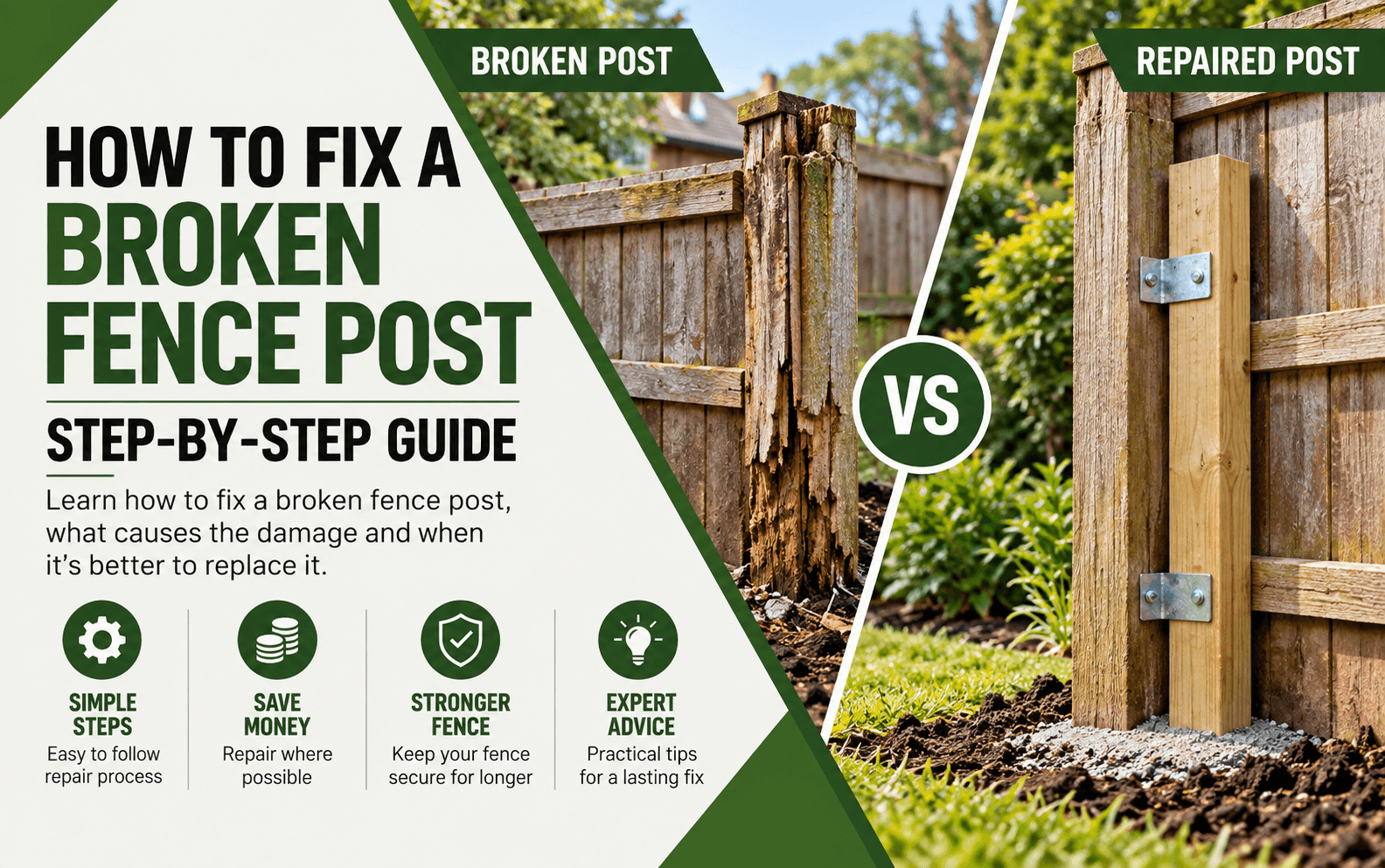
A broken fence post can quickly make a fence lean, loosen the panels and become unstable in strong winds. The damage often starts around ground level, where timber is more exposed to moisture, rot and movement.
Ignoring the problem can put extra pressure on the surrounding posts and panels, leading to more repairs later. A small crack or loose base may only need reinforcement, but severe rot or a snapped post can require replacement.
The good news is that many broken fence posts can be repaired without replacing the entire fence. The right method depends on where the post has failed, how badly it is damaged and whether the surrounding concrete or ground fixing is still secure.
At William Bradley Fencing, we repair and replace damaged fence posts across Surrey and nearby areas. Our fence repair service covers broken and leaning posts, damaged panels and weather-related fence damage. We assess the condition of the post, surrounding panels and existing base to recommend the most suitable repair or replacement method.
Key Takeaways
|
What Causes a Fence Post to Break?
The most common causes of a broken fence post are timber rot, strong winds, ground movement, impact damage and poor installation. In many cases, the damage starts near ground level, where moisture can weaken the timber and make the post more likely to crack or snap under pressure.
- Timber Rot: Moisture can collect around the base of a wooden post and gradually weaken the timber.
- Strong Winds: Wind places pressure on fence panels, which transfers force directly to the posts.
- Ground Movement: Soil can shift, shrink or become waterlogged, causing the post to loosen or lean.
- Impact Damage: Garden equipment, vehicles or falling branches can crack or snap a post.
- Poor Installation: Posts set too shallow, with insufficient support or weak concrete, may fail sooner.
- Age and General Wear: Older timber can lose strength after years of exposure to rain, frost and changing temperatures.
- Extra Weight on the Fence: Heavy panels, trellis, climbing plants or gates can place additional strain on a fence post.
William Bradley Fencing Tip: Pay particular attention to the base of timber posts. This is often where moisture damage starts, and a post can look sound above ground even when the timber around ground level has already weakened.
What Do You Need to Fix a Broken Fence Post?
To fix a broken fence post, you usually need basic hand tools, including a hammer, drill, spirit level, spade, suitable fixings and a fence post repair support.
- Work gloves: Protect your hands when handling damaged timber and concrete.
- Safety glasses: Help protect your eyes from dust, timber fragments and debris.
- Hammer: Useful for removing old fixings and securing new ones.
- Screwdriver or drill: Needed for removing and installing screws or brackets.
- Spirit level: Helps keep the post upright during the repair.
- Spade or digging tools: Required if you need to expose the base of the post.
- Fence post repair spur or support: Used to reinforce a weakened or broken post.
- Exterior-grade screws or bolts: Secure the repair support to the existing post.
- Postcrete or concrete: May be needed if the base or footing has to be reset.
- Replacement timber: Required if damaged sections, rails or fixings also need replacing.
How to Fix a Broken Fence Post?
You can fix a broken fence post by supporting the fence, removing damaged timber, fitting a suitable repair spur or post support, securing it firmly and checking the post is level and stable. The exact method depends on whether the post is cracked, rotten, loose or broken at ground level.
1. Inspect the Damage
Check whether the post is cracked, rotten, loose or completely snapped. Confirm that enough solid timber remains for a secure repair.
2. Support the Fence
Support the nearby panels before starting work. This prevents extra movement and reduces pressure on the damaged post.
3. Clear Around the Post Base
Remove soil, plants and loose material around the base. Expose enough of the post and footing to see the damaged area clearly.
4. Remove Loose or Rotten Timber
Remove loose or crumbling timber that cannot support a fixing. Avoid cutting away sound timber unnecessarily.
5. Dig Beside the Existing Post
Create enough space beside the post for the repair spur or support. Avoid disturbing more of the existing footing than necessary.
6. Position the Repair Spur
Place the spur next to the solid section of the post. Use a spirit level to keep the post upright and aligned with the fence.
7. Secure the Spur to the Post
Drill the required fixing points and attach the spur using suitable exterior-grade bolts or screws. Tighten the fixings securely.
8. Secure the Support in the Ground
Use suitable concrete or Postcrete where required. Keep the post braced and check the level again before the material sets.
9. Reattach the Fence Panel
Refit any panels, rails or fixings removed during the repair. Replace damaged components where necessary. If several parts of the fence have deteriorated, it may also be worth checking whether sections of the existing timber fencing need repair or replacement.
10. Check the Fence Stability
Test the repaired post for movement and check that the panels remain level. The post should feel firm and stay aligned with the rest of the fence.
Note: Before considering the job finished, we would check that the timber remains solid, the footing does not move, and the repaired post stays level under light pressure.
Can You Fix a Broken Fence Post Without Removing the Concrete?
Yes, you can sometimes fix a broken fence post without removing the existing concrete if enough solid timber remains and the footing is still stable. This method works best when the damage is localised, and the remaining timber is strong enough to hold a repair support securely.
If the concrete footing is cracked, loose or moving, or the post is badly rotten below ground, replacing the post and footing is usually the better option.
William Bradley Fencing Tip: Do not assume the concrete is sound just because it has not visibly cracked. Test whether the footing moves when pressure is applied to the post. Movement in the footing can indicate that a more complete replacement is needed.
Repairing vs Replacing a Broken Fence Post
Repairing or replacing a damaged fence depends on the extent of the damage, the condition of the posts and panels, and whether the existing structure is still stable enough to support a lasting repair.
Repairing a broken fence post is usually suitable when the damage is localised, the remaining timber is still solid, and the footing is stable. However, replacement is better when the post has extensive rot, major structural damage or movement below ground.
| Factor | Repairing the Post | Replacing the Post |
|---|---|---|
| Minor cracks | Often suitable | Usually unnecessary |
| Localised ground-level damage | Can often be reinforced | May not be needed |
| Extensive rot | Usually unsuitable | Better option |
| Stable concrete footing | Supports a repair | Can remain if suitable |
| Loose or failed footing | Less suitable | Usually recommended |
| Limited movement | May be repairable | Depends on damage |
| Major split or snapped post | Often unsuitable | Usually better |
| Cost and labour | Usually lower | Usually higher |
When Should You Replace a Broken Fence Post Instead of Repairing It?
You should replace a broken fence post when the timber has lost too much strength for a secure repair. Replacement is usually the better option if the damage affects the base, extends through a large section of the post or has also caused the footing to fail.
- Severe rot: Soft, crumbling timber around the base will not hold a repair securely.
- Complete break: A post that has snapped through usually needs replacing.
- Major splits: Deep cracks running through most of the post can significantly reduce its strength.
- Failed footing: Loose, cracked or moving concrete can make the whole post unstable.
- Extensive below-ground damage: Rot or breakage beneath ground level is difficult to reinforce reliably.
- Repeated movement: A post that keeps leaning or loosening after repair may need full replacement.
- Wider fence damage: If the surrounding rails, panels and posts are also failing, replacement may provide a longer-lasting result.
How to Replace a Broken Fence Post?
To replace a broken fence post, remove the attached panel, take out the damaged post and old concrete, prepare the hole, position the new post, secure it with concrete and refit the fence panel.
Step 1: Remove Panel: Detach the fence panel or rails from the broken post.
Step 2: Remove Post: Take out the damaged timber and loose material.
Step 3: Clear Concrete: Remove old concrete if it blocks the new post.
Step 4: Prepare Hole: Make sure the hole is suitable for the replacement post.
Step 5: Position Post: Set the new post upright and check the level.
Step 6: Secure Post: Add concrete or Postcrete around the base.
Step 7: Refit Panel: Reattach the fence and check that it is stable.
What Mistakes Should You Avoid When Fixing a Broken Fence Post?
The mistakes to avoid when fixing a broken fence post include ignoring rot, failing to check the concrete footing, using weak fixings, leaving the post out of level and trying to repair timber that is too badly damaged.
- Ignoring rot: Do not attach a repair support to soft or badly decayed timber.
- Skipping the footing check: A solid-looking post can still move if the concrete base has failed.
- Using weak fixings: Indoor screws or undersized fixings may not hold the repair securely.
- Failing to level the post: Always check the post with a spirit level before securing it.
- Repairing severe damage: A badly split or heavily rotten post is usually better replaced.
- Leaving loose panels: Unstable panels can keep putting pressure on the repaired post.
- Rushing the concrete: Allow fresh concrete or Postcrete to set before loading the fence.
Can You Fix a Broken Fence Post Yourself?
Yes, you can repair some broken fence posts yourself when the damage is localised, the remaining timber is sound, and the concrete footing is stable.
A repair spur or suitable support can often reinforce minor cracks, limited movement or localised damage around the base. If the post has severe rot, major movement or structural failure, the repair may require more extensive work.
When Should You Call a Professional for a Broken Fence Post?
You should call a professional when the fence post is badly rotten, snapped below ground, set in a failed concrete footing or supporting heavy fence panels. In addition, professional help is recommended when several posts are damaged, or the fence has become unstable.
- Severe rot: The remaining timber may be too weak to hold a secure repair.
- Broken below ground: Removing the old post and footing can be difficult.
- Failed concrete base: A loose or cracked footing may need to be fully replaced.
- Multiple damaged posts: Wider fence problems often need more than a single repair.
- Heavy or unstable panels: Large panels can make the job harder and less safe to manage alone.
- Repeated failure: If a previous repair has not lasted, the post may need replacing properly.
What We Check Before Repairing a Fence Post
Before repairing a fence post, we check whether the remaining timber is strong enough to hold a secure fixing and whether the damage is limited to one area. A post may look solid above ground but still have rot or weakness around the base.
We also check the concrete footing for movement, the condition and weight of the connected fence panels, and whether nearby posts have started leaning. If the footing is loose or the surrounding fence is already unstable, reinforcing one post may not provide a reliable long-term repair.
Conclusion
Fixing a broken fence post starts with checking the condition of the timber, the footing and the surrounding fence. Minor cracks, limited movement and localised damage can often be repaired with a suitable support, but badly rotten or unstable posts are usually better replaced.
The right repair should leave the post level, secure and able to support the fence properly. If the damage is extensive or several posts are affected, professional help can prevent further movement and more costly repairs.
If you need help with a damaged fence, William Bradley Fencing provides professional fence repair services across Surrey and nearby areas. With over 10 years of experience, the team can assess the damage, recommend the right repair and arrange a site visit where needed. You can also view our recent fencing projects or contact us to arrange a site visit.
FAQs
Can a broken fence post be repaired?
Yes, a broken fence post can often be repaired if the damage is localised, enough solid timber remains, and the concrete footing is still stable. If the post is badly rotten, snapped below ground or loose in a failed footing, replacement is usually the better option.
How do you know if a broken fence post can be repaired?
You can tell if a broken fence post can be repaired by checking whether the timber is still solid, the damage is limited to one area, and the concrete footing remains stable. If the post has severe rot, major splits or excessive movement at the base, replacement is usually the better option.
How can you prevent fence posts from breaking?
You can prevent fence posts from breaking by using pressure-treated timber, installing posts at the correct depth, keeping the concrete footing stable and protecting the base from excess moisture. Regularly checking for rot, loose fixings and leaning posts can also help you deal with small problems before they lead to failure.
What is the easiest way to fix a broken fence post?
The easiest way to fix a broken fence post is usually to reinforce it with a fence post repair spur or support, provided the timber is still solid and the concrete footing is stable.
Can you fix a fence post that has rotted at the bottom?
Yes, a fence post that has rotted at the bottom can sometimes be repaired if enough solid timber remains and the footing is stable. If the rot is extensive or the base has lost most of its strength, replacing the post is usually the safer long-term option.