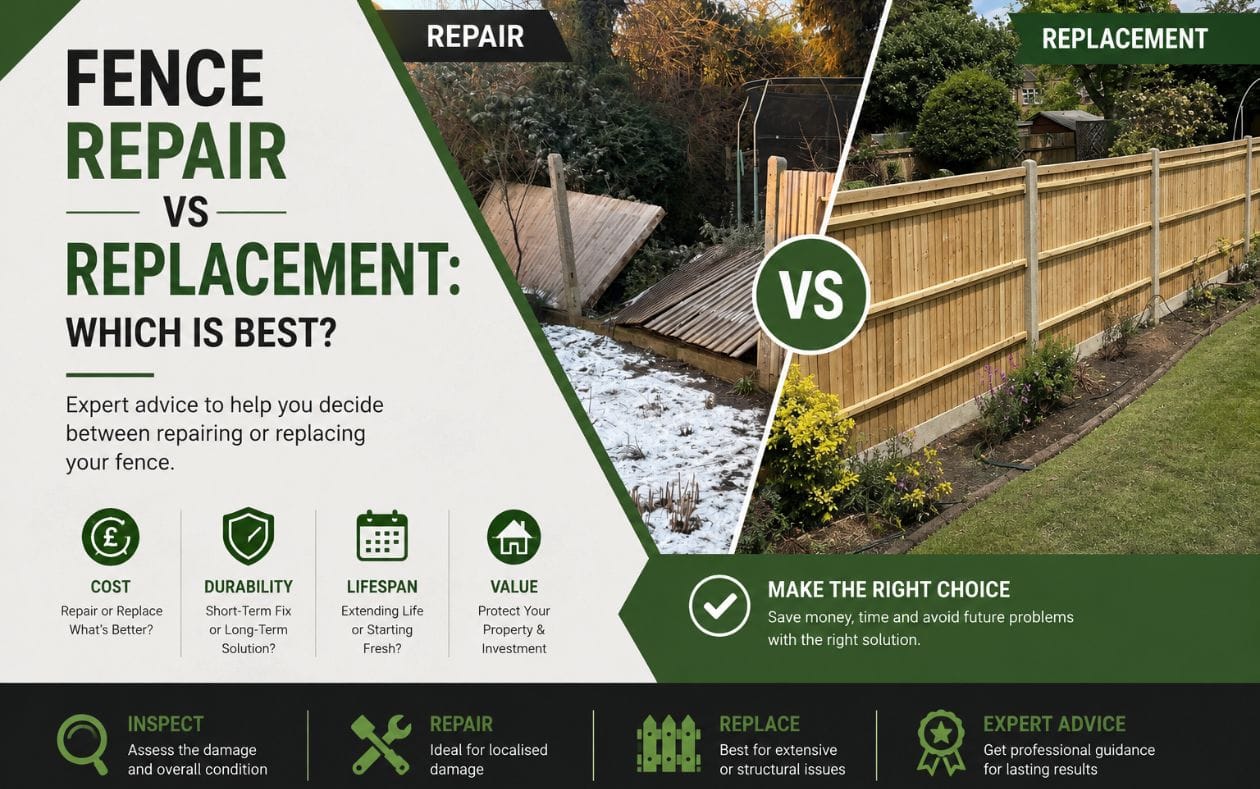
Has your fence started leaning, lost a few panels after strong winds, or developed signs of rot? When damage appears, one of the first questions most homeowners ask is whether it’s worth repairing the fence or if replacing it would be the better long-term solution.
The right choice depends on the overall condition of your fence, not just the damaged section. The age of the fence, the condition of the posts, how far the damage has spread, and whether the structure is still strong enough all help determine whether a repair will provide a lasting solution or if a full replacement is the better option.
At William Bradley Fencing, we carry out fence repairs and new fence installations across Surrey, so we know that every fence is different. Our recommendations are based on the condition of your fence and the solution that offers the best long-term value. This guide explains how to tell whether your fence should be repaired or replaced and what experienced fencing installers look for during an inspection.
Key Takeaways
|
What are the Advantages and Disadvantages of Fence Repair vs Replacement?
The advantages and disadvantages of fence repair or replacement depend on the condition of your fence. A repair is often suitable for minor damage, whereas replacement is usually the better option for more extensive damage.
Fence Repair
Pros
- Usually costs less when the damage is limited to one area.
- Causes less disruption because only the damaged section is repaired.
- Preserves the existing fence if it remains structurally sound.
- Can extend the lifespan of a well-maintained fence.
Cons
- May not solve the problem if the fence has widespread damage.
- Matching older or weathered materials isn’t always possible.
- Other parts of the fence may need repairing in the future.
Fence Replacement
Pros
- Provides a completely new, strong and secure fence.
- Resolves structural problems that repairs can’t fix.
- Gives you the opportunity to upgrade the style, height or fencing material.
- Reduces the need for ongoing repairs.
Cons
- Usually costs more than repairing a small section.
- Takes longer because the existing fence needs to be removed first.
How to Know Whether Your Fence Needs Repair or Replacement?
The best way to know whether your fence needs repairing or replacing is to assess the condition of the entire fence, including the posts, rails, boards and overall stability. If the damage is isolated, a repair is often enough. If several parts of the fence have deteriorated or become unstable, replacing it is usually the better long-term option.
1. Broken or Missing Fence Boards
A few damaged boards don’t usually mean the whole fence needs replacing. If the posts, rails and surrounding sections are still strong, replacing the affected boards is often enough to restore the fence. We regularly carry out this type of repair after storm damage or accidental impact, helping homeowners avoid the cost of a complete replacement.
2. Leaning or Unstable Fence Posts
Fence posts provide the structural support for the entire fence. A single leaning post may only need replacing if the rest of the fence remains stable. However, when several posts have become loose because of rot, failing concrete footings or ground movement, replacing the fence is often the safer and more cost-effective option.
3. Rot and Timber Decay
Rot should be assessed based on how far it has spread through the fence. From our experience, replacing a single rotten post, rail, or board can often extend the fence’s lifespan. However, when rot affects multiple structural components, the fence is unlikely to provide long-term stability, making replacement the better option.
4. Loose or Broken Fence Rails
Loose or broken fence rails can often be repaired if the damage is limited to one or two sections and the fence posts remain secure. However, if several rails have split, come loose or been pulled away from the posts, it’s usually a sign the fence has weakened structurally. In these cases, replacing the fence is often the more reliable and cost-effective long-term solution.
5. Storm Damage
Storm damage can often be repaired if it’s limited to one section of the fence. We’ve seen cases where a single fallen panel or broken rail was replaced, leaving the rest of the fence intact. However, if high winds have affected multiple panels, posts and rails, it’s usually a sign that the fence has lost its structural stability and should be replaced rather than repaired.
6. Repeated Repairs
Occasional fence repairs are part of maintaining a timber fence. However, if you’re replacing posts, rails or boards on a regular basis, it’s often a sign that the fence is no longer performing as it should. In these situations, inspecting the whole fence helps identify the most suitable next step.
7. The Overall Age and Condition of the Fence
An older fence can often be repaired if the posts, rails and boards remain in good condition. Equally, a newer fence may need replacing if several structural components have failed. From our experience, the overall condition of the fence is always a better indicator than its age.
Fence Repair vs Replacement at a Glance
| Feature | Fence Repair | Fence Replacement |
|---|---|---|
| Best for | Minor or localised damage | Widespread damage or ageing fences |
| Cost | Usually lower | Usually higher |
| Time to Complete | Faster | Longer |
| Disruption | Minimal | More disruption during installation |
| Lifespan | Extends the life of a sound fence | Provides a new fence with a full lifespan |
| Long-Term Maintenance | May require future repairs | Usually requires less maintenance initially |
At William Bradley Fencing, we don’t base our recommendations on a single broken panel or leaning post. We look at how every part of the fence is performing to determine whether a repair will provide lasting value or if replacing the fence is the better long-term solution.
Is It Cheaper to Repair or Replace a Fence?
In many cases, repairing a fence costs less than replacing it because only the damaged sections need to be repaired or replaced. However, if several parts of the fence have started to fail, the cost of repeated repairs can soon add up, making a new fence the more sensible option.
At William Bradley Fencing, we’ve often inspected fences where a homeowner expected a small repair, but the inspection revealed that several posts, rails or panels had already deteriorated. In those situations, we explain both options and recommend the one that’s likely to give the best result, rather than simply carrying out the smallest job.
The overall cost depends on several factors, including:
- Extent of the damage: Repairing one damaged panel or post is usually less expensive than repairing several sections.
- Type of fencing: Different fencing materials require different repair methods and replacement materials.
- Amount of labour involved: Small repairs can often be completed quickly, whereas replacing an entire fence takes more time.
- Length of the fence: A longer boundary generally requires more materials and labour.
- Availability of matching materials: Older fencing or weathered timber can sometimes be more difficult to match.
What Do We Assess Before Recommending a Fence Repair or Replacement?
Before recommending a fence repair or replacement, it’s important to assess the condition of the entire fence. This helps identify the underlying cause of the damage and determine whether a repair will provide a lasting solution or if replacing the fence is the better option.
- Fence Posts: We start by checking the fence posts because they support the entire structure. If they’re rotten, loose or leaning, repairing individual boards or rails may not solve the problem.
- Rails and Boards: Our team checks for split rails, damaged boards and loose fixings to determine whether the damage is confined to one area or affecting a larger section of the fence.
- Overall Stability: We assess whether the fence remains stable or if movement and leaning indicate more significant structural issues.
- Extent of the Damage: Localised damage can often be repaired, whereas deterioration across several sections may point towards replacement.
- Previous Repairs: Earlier repairs help us identify whether the damage is an isolated issue or part of an ongoing pattern of deterioration.
- Ground Conditions: We also check the ground around the posts for movement, poor drainage or unstable footings that may have contributed to the damage.
If you’re still unsure which option is right for your fence, a professional inspection can help you make an informed decision. At William Bradley Fencing, every recommendation is based on the condition of your fence. Request a free quote to arrange an assessment.
How to Choose a Fencing Company for Repairs or Replacement?
To choose the right fencing company for repairs or replacement, look for a contractor with proven experience, quality workmanship and a portfolio of previous projects. This helps you assess the standard of their work and gives you confidence that they’ll recommend the most suitable solution for your fence.
- Experience: Choose a contractor with experience carrying out both fence repairs and complete fence replacements.
- Previous Projects: Review completed projects to assess the quality of workmanship and see whether the company has completed similar fencing work. You can view our recent fencing projects across Surrey.
- Quality Materials: Ask what materials will be used and whether they are suitable for your property and budget.
- Clear Quotations: Make sure the quotation clearly outlines the recommended work, materials and what’s included before the project begins.
- Customer Reviews: Read recent reviews to understand the company’s reliability, workmanship and customer service.
Conclusion
Deciding whether to repair or replace a damaged fence depends on the extent of the damage, the age of the fence, and your long-term plans for your property. Minor damage can often be repaired, but if the fence has widespread rot, structural issues, or is nearing the end of its lifespan, replacing it is usually the better long-term investment.
With years of experience, William Bradley Fencing provides professional fence repair and replacement services tailored to your property’s needs. Our team will assess the condition of your existing fence, explain the most practical option, and deliver high-quality workmanship using durable materials.
Not sure whether your fence should be repaired or replaced? Contact us today for a free quote. We’ll inspect your fence, discuss your requirements, and recommend the most cost-effective solution to restore your garden’s privacy, security, and appearance.
FAQs
Can you repair part of a fence instead of replacing the whole fence?
Yes. If the damage is limited to one section and the rest of the fence remains strong and stable, it’s often possible to repair or replace individual posts, rails, boards or panels without replacing the entire fence.
Should I repair or replace a fence after storm damage?
Yes, if the storm damage is limited to one section and the rest of the fence remains stable, a repair is often enough. If the damage has affected multiple posts, panels or rails, replacing the fence is usually the better option.
Can a single damaged fence panel be replaced?
Yes. A single damaged fence panel can often be replaced if the posts and surrounding fence remain in good condition. This helps restore the fence’s strength and appearance without replacing the entire boundary.
Does repairing or replacing a fence add value to a property?
Yes. Repairing or replacing a damaged fence can improve your property’s appearance, privacy and security, which may make it more attractive to potential buyers and help maintain its value.